Physical Sciences
Particle Physics
1928
ResearchDirac Equation
Relativistic wave equation for spin-½ particles—predicting antimatter.
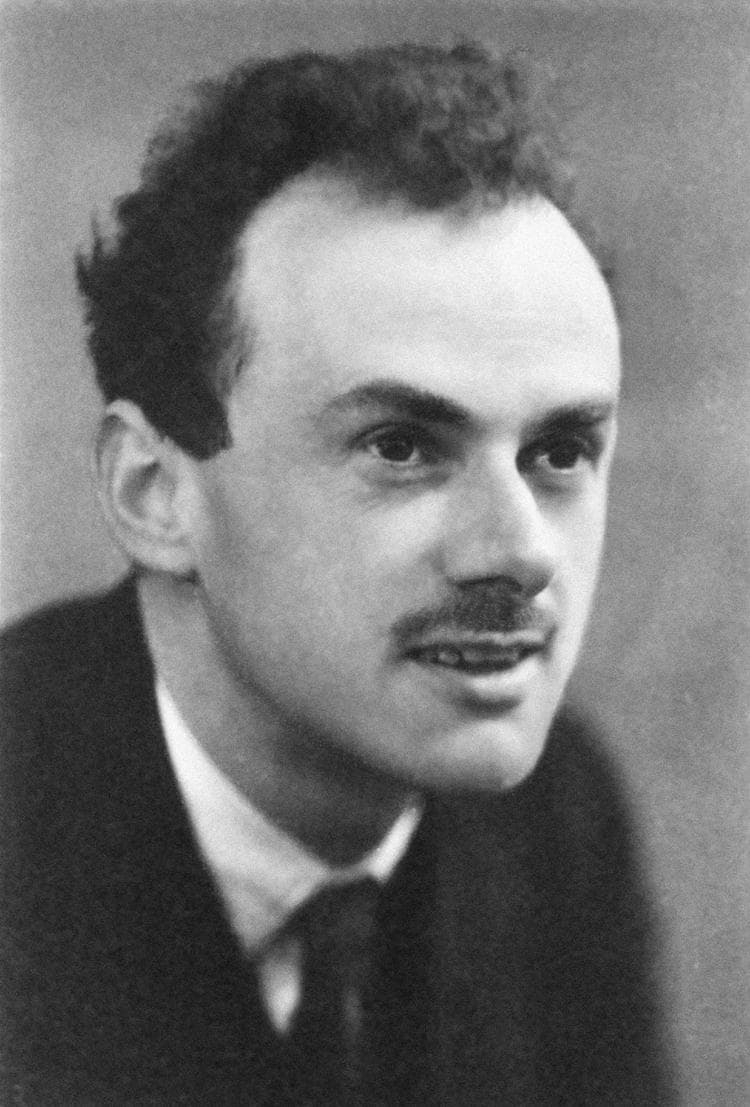
By Paul Dirac
Physical Sciences
Dirac Equation
1928 · Paul Dirac
Human Reviewed
84%
Rabbit Hole Mode
Five doors into the universe behind this equation. Choose your path.
Story PortalWho discovered this?Discover how Paul Dirac and others shaped this equation.Visual PortalWhat does it look like?See the equation come alive in the Visual Studio.Machine PortalWhere is it used?Explore machines powered by this equation — pet scans.Math PortalWhat does it derive from?Trace the mathematical lineage from schrodinger equation.Future PortalWhere is it going?Topological quantum computing
Why it matters: Foundation of particle physics, QED, and the Standard Model.
Discoverers: Paul Dirac (1928)
What does it mean?
Relativistic wave equation for spin-½ particles—predicting antimatter.
Why should I care?
Foundation of particle physics, QED, and the Standard Model.
Equation Compass
North — Prerequisites
West — History
East — Applications
South — Derivations
Variables & Units
| Symbol | Name | Unit | Meaning |
|---|---|---|---|
| Spinor | — | Four-component wave function | |
| Mass | — | Particle rest mass | |
| Gamma matrices | — | Dirac matrices |
Worked Example
Positron discovered 1932, confirming Dirac's prediction.
AI Guide (Pro)
Ask questions about equations and get answers grounded in the Equation Universe catalog.
Pictures & video
Sources & further reading
Share this equation
Equation Universe
Dirac Equation

Real-world impact
Modern electronics
Electrostatic design at nanometer scales.
Photo: Unsplash — microchip
Relativistic wave equation for spin-½ particles—predicting antimatter.
equation-universe.vercel.app