Schrödinger Equation
The wave function of a quantum system evolves according to its energy operator.
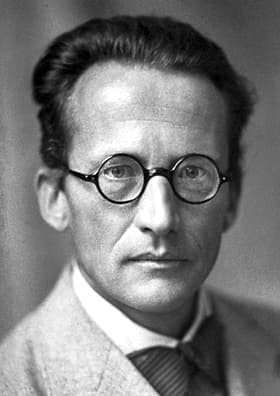
By Erwin Schrödinger
Rabbit Hole Mode
Five doors into the universe behind this equation. Choose your path.
Discoverers: Erwin Schrödinger (1926)
What does it mean?
The wave function of a quantum system evolves according to its energy operator.
Why should I care?
Foundation of quantum chemistry, semiconductors, lasers, and modern technology.
Equation Compass
North — Prerequisites
West — History
East — Applications
South — Derivations
Variables & Units
| Symbol | Name | Unit | Meaning |
|---|---|---|---|
| Wave function | — | Quantum state | |
| Hamiltonian | — | Energy operator | |
| Reduced Planck | — | h/(2π) |
Worked Example
AI Guide (Pro)
Ask questions about equations and get answers grounded in the Equation Universe catalog.
Continue your trail
Pictures & video
Sources & further reading
Share this equation
Equation Universe
Schrödinger Equation

Real-world impact
Semiconductors & lasers
Quantum wavefunctions underpin transistors, LEDs, and quantum computing.
Photo: Unsplash — quantum computing
The wave function of a quantum system evolves according to its energy operator.
equation-universe.vercel.app